The obligation to install photovoltaic (PV) systems on buildings now affects virtually every owner of residential property in Germany, as it no longer applies only to newly constructed buildings but also to existing buildings.
The following article therefore provides an initial overview of the PV installation obligation. For an assessment of whether the PV installation obligation applies to your project, or for questions regarding your specific case, please contact your SKW Schwarz advisor.
Where Is the PV Installation Obligation Regulated by Law?
The central federal law governing energy requirements for buildings is the German Building Energy Act (Gebäudeenergiegesetz – GEG), which entered into force on November 1, 2020. The GEG itself does not establish a nationwide obligation to install PV systems. Instead, Section 9a GEG authorizes the federal states (Länder) to adopt more extensive regulations.
Section 9a GEG therefore provides:
“The federal states may, by state law, impose more extensive requirements regarding the generation and use of electricity, heat, and cooling from renewable energy sources in connection with buildings, as well as further requirements or restrictions concerning direct electric heating systems.”
Whether a PV installation obligation exists therefore depends on the specific state regulations in the federal state where your project is to be carried out.
Overview of the PV Installation Obligations in the German Federal States
The following table (as of May 17, 2026) provides an overview of whether a PV installation obligation exists in each federal state and the legal provisions on which it is based:
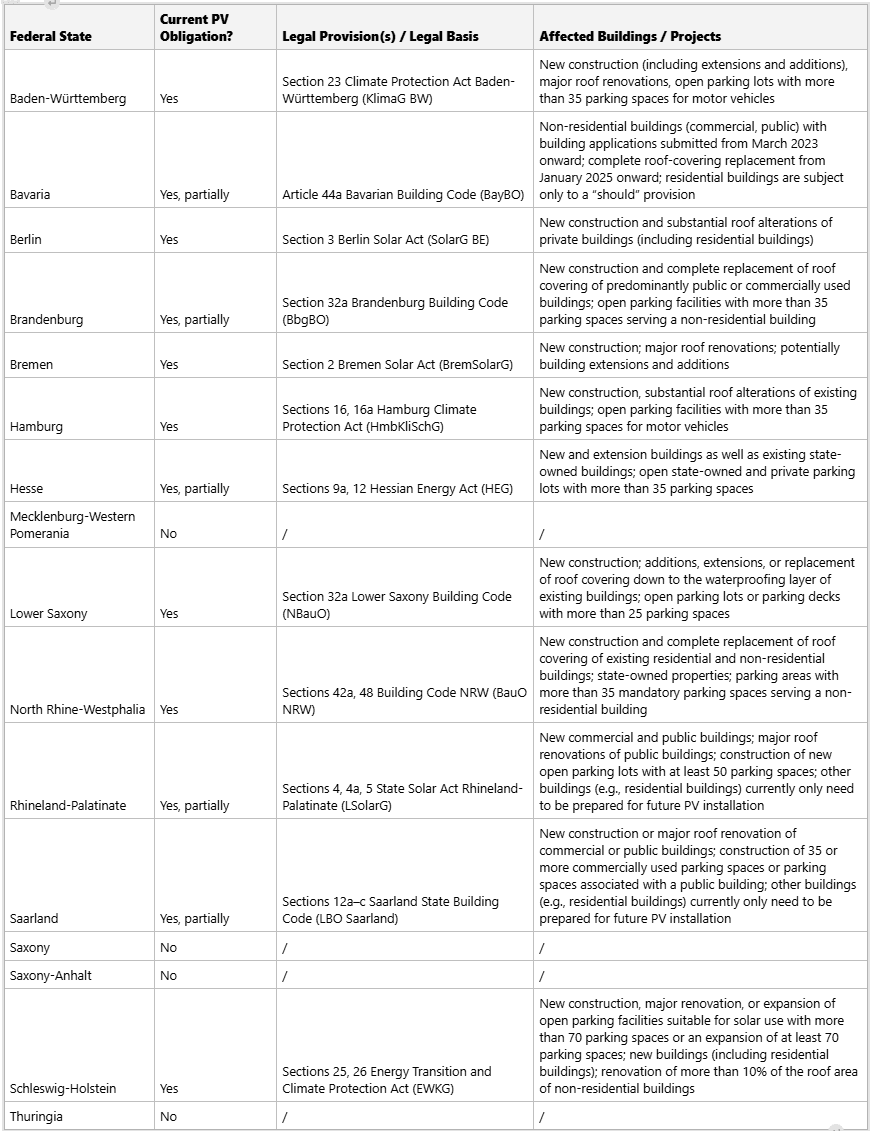
Due to the large number of state-specific regulations, this table can only provide a general overview. A legal assessment of each individual case remains necessary. Even in federal states where no statutory state-level PV obligation exists, an obligation may exceptionally arise from a local development plan or municipal regulations.
Exceptions and Exemptions from the PV Installation Obligation – The Example of Lower Saxony
Even if a PV installation obligation generally exists in your federal state, this does not mean that it always applies. The following examples from the Lower Saxony Building Code (NBauO) illustrate this.
1. Cases in Which No PV Obligation Exists Under Section 32a(2) NBauO
According to the wording of Section 32a(2) NBauO, the obligation to equip 50% of the roof area with a solar energy installation for electricity generation applies only if the newly constructed or renovated roof area amounts to at least 50 m².
As an additional requirement, Section 32a(2) No. 3 NBauO requires “replacement of the roof covering down to the waterproofing layer.” If a roof is re-covered without such a “major roof renovation,” no PV obligation is likely to arise.
Accordingly, it is always necessary to examine and document whether the project reaches the relevant size threshold and scope. Similar considerations apply in other federal states with PV obligations.
2. Statutory Exceptions to the PV Obligation Under Section 32a(4) NBauO
Section 32a(4) sentence 1 NBauO provides several exceptions to the PV installation obligation. It should be noted that the provision uses the term “insofar as,” meaning that the obligation may be reduced only partially rather than waived entirely.
a) The PV Obligation Conflicts with Other Public-Law Requirements (Section 32a(4) Sentence 1 No. 1 NBauO)
Conflicts with other public-law requirements are likely to be exceptional and may arise, for example, from provisions in a development plan (e.g., requirements regarding green roofs) or from heritage protection regulations. Comparable provisions exist in other federal states.
b) The PV Obligation Is Technically Impossible (Section 32a(4) Sentence 1 No. 2 NBauO)
Technical impossibility may exist, for example, where the roof or building structure lacks sufficient load-bearing capacity, structural stability, or connection possibilities, or where there are no sufficiently large flat roof surfaces due to numerous small roof sections.
Buildings with predominantly north-, northwest-, or northeast-facing roofs, or roofs subject to significant shading, may also fall under this exception. Comparable provisions exist in other federal states.
c) The PV Obligation Is Not Economically Reasonable (Section 32a(4) Sentence 1 No. 3 NBauO)
In Lower Saxony, a PV obligation is generally considered economically unreasonable if an optimized solar energy installation would not pay for itself within 20 years, meaning that the investment costs could not be offset through revenues or savings (in the case of self-consumption systems) during that period, or if the building has an expected remaining useful life of less than 20 years.
The obligation is also considered economically unreasonable if the requirement to install a solar energy system would render the construction project economically unfeasible. Other federal states may apply different standards.
d) Solar Thermal Systems Have Been or Will Be Installed on the Roof Area (Section 32a(4) Sentence 1 No. 4 NBauO)
The roof area required for such a solar thermal installation may be deducted proportionally from the available roof area and the minimum occupancy requirement.
If the remaining available roof area is less than 50 m², or if 50% of the roof area is already occupied, the PV installation obligation no longer applies.
e) Exception Under Section 32a(4) Sentence 2 NBauO
Under this provision, the obligations under Section 32a(2) No. 3 and Section 32a(3) Sentence 2 NBauO may also be waived where the construction measure is urgently required due to special external circumstances, particularly to remedy unforeseen damage caused by environmental events.
For example, this exception may apply where a roof has sustained damage (e.g., as a result of environmental events) that necessitates involuntary roof replacement within the meaning of Section 32a(2) No. 3 NBauO.
Conclusion
As PV installation obligations now exist in almost all German federal states, they should be taken into account at an early stage when constructing new buildings and when planning roof renovations, vertical extensions, or alterations to existing buildings.
Even where property owners are convinced that no obligation applies in their specific case, thorough documentation of the relevant facts is strongly recommended.
We would be pleased to advise you on whether your construction project is subject to the PV installation obligation or whether a statutory exception may apply in your particular circumstances.

'/%3e%3c/svg%3e)
'/%3e%3c/svg%3e)